TOTP 23 JUL 1999

What’s going on here then. Why have we missed two episodes? This hasn’t happened since the Summer of 1997 repeats and that whole Puff Daddy/ P Diddy business. The ever reliable @TOTPFacts has the answer:

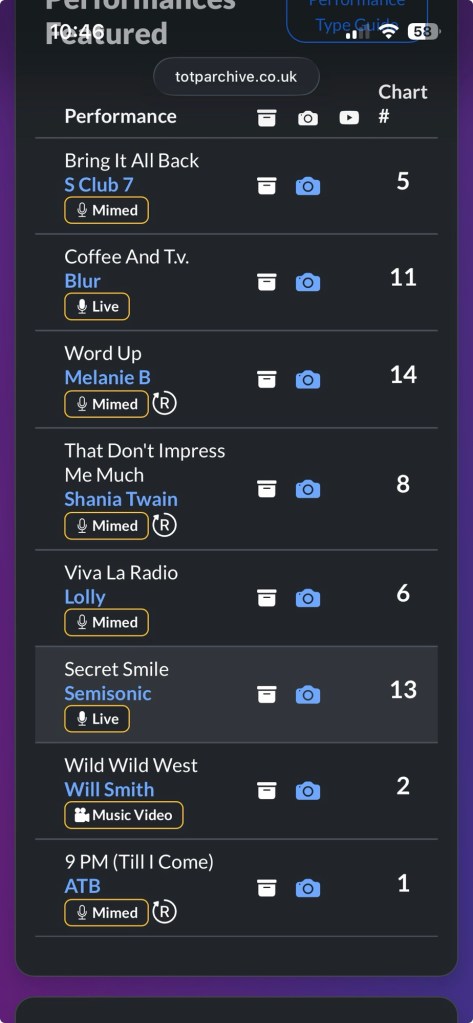
Well, there you go. Some in the online TOTP community were disgruntled at the decision by the BBC with the usual “couldn’t they have blurred it out?” comments and I understand their opinion especially as the Gouryella track was only featured during the chart rundown and not as a standalone showing of the video. Looking at the running order for these two missed episodes though, I can’t say I’m that disappointed not to have watched (and reviewed) some of the hits we missed. Look at this line up from the 9th July episode:

The unofficial home of TOTP website: https://totparchive.co.uk/episode.php?id=1842

I would say that there’s only Blur’s “Coffee & TV” and “Secret Smile” by Semisonic that piqued my interest and I certainly had no desire to review S Club 7 and Shania Twain again and I could live without Lolly as well. As for the 16th July episode…

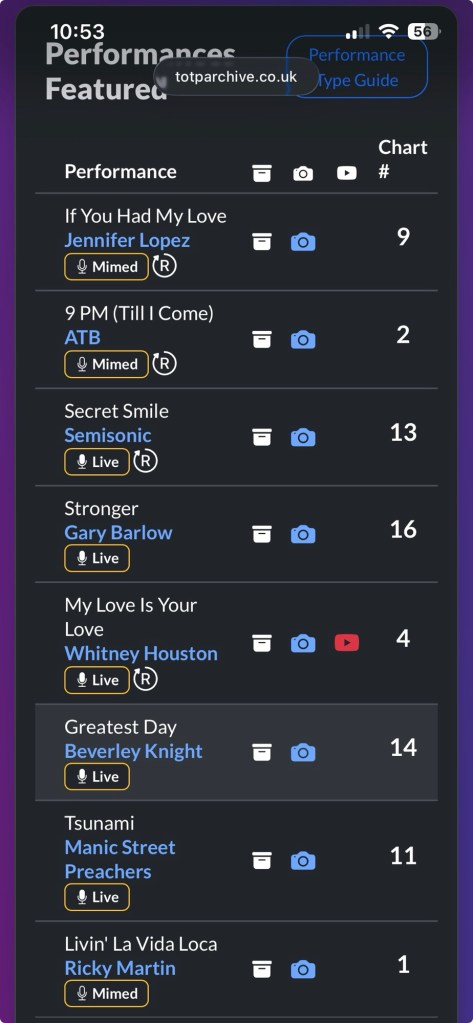
The unofficial home of TOTP website: https://totparchive.co.uk/episode.php?id=1843

Manic Street Preachers? I can’t see much else. Well, I haven’t got it in me to dig out those shows on YouTube and review them I’m afraid (especially after seeing the running orders) so it’s full steam ahead with the 23rd July episode which is hosted by Jayne Middlemiss and we start with a new one from Steps called “Love’s Got A Hold On My Heart”. After the almost novelty record debut of “5,6,7,8” and the faux ABBA schtick of their next two releases, their cover of “Tragedy” drew a line in the sand where the group had to taken seriously as a genuine chart entity when it finally made it to No 1 after an ascent that took weeks. The follow up “Better Best Forgotten” leapt to No 2 and so when “Love’s Got A Hold On My Heart” was released as the lead track from second album “Steptacular”, its peak of No 2 was maybe the least that was expected of it. However…talk about playing it safe. Co-produced and co-written by Pete Waterman, this was just a retread of his PWL pomp. You could imagine Sonia (definitely not Kylie though) having recorded this tripe. Everything from its title to its sound was telegraphed. There was nothing new nor original here but maybe it was expecting too much for it to have been anything else.

As for the performance we see here, there’s something curious going on. At the end of the 2nd July show, as Gail Porter introduces the No 1 surrounded by the studio audience, front and centre in the crowd are Steps in the yellow outfits they wore in this, the 23rd July episode. Claire even has the same cowboy hat on. Yet more evidence that there was clearly a time delay between when performances were recorded and when they were broadcast. I assume that the artists had busy schedules and so everything had to be carefully timetabled to accommodate a TOTP studio appearance rather than just show the single’s promo video which executive producer Chris Cowey was very determined not to if he could help it.

Look at this! Madness were back! Had they actually been away though? OK, some clarification is required here. After initially disbanding in 1986, there had already been a number of returns by the nutty boys before this point. In 1988, four members of the original band reunited as The Madness and released one album and two singles none of which troubled the chart compilers. Two years on and now down to two original members, The Nutty Boys were formed before changing their name to Crunch! but there really was no appetite for just the pips of the band and they were soon compost. Everything changed though in 1992 when all seven members came back together to promote the Best Of compilation “Divine Madness” and to play the Madstock! festival in Finsbury Park to 75,000 people over two days. Legend has it that some nearby tower blocks perceptibly shook so loud was the music. Madness were officially a smash again with “Divine Madness” going to No 1 and triple platinum in the UK. Four singles were released from it three of which charted Meanwhile, Madstock was repeated three times as a biannual event.

So, why would I say that Madness were suddenly back in 1999? Ah well, this was the first time that they had released new material since that break up in 1986 when “(Waiting For) The Ghost Train” made No 18. “Lovestruck” was the lead single from “Wonderful”, their first studio album since 1985’s “Mad Not Mad” and listening back to it now, it could easily have been released in the 80s. It was trademark Madness with Mike Barson’s tinkling keyboards back in the fold for the first time since his departure in 1984. Despite sticking out in a 1999 Top 40 like a pork pie hat at Royal Ascot, “Lovestruck” returned Madness to the Top 10 for the first time since “The Sun And The Rain” in 1983. There were a lot of ‘first since’ milestones going on in this comeback!

I’m (love) struck by the unique singing style of Suggs on this track. It’s verges on non-singing which I guess you would almost describe as ‘speaking’ and yet it has served him and his band well for nearly 50 years now. Is it heresy to say that secondary vocalist Chas Smash had the better voice? Certainly, I can hear his harmonies to good effect in this one. “Wonderful” sold reasonably rather than exceptionally well but enough for the band to remain a part of our lives ever since releasing a further five studio albums since and being an almost ever present touring outfit. Embrace the madness!

Some anti-London sentiment now according to Jayne Middlemiss who plays up to her North East roots in her intro to “Londinium” by Catatonia by saying “I dirrn’t knaa wot she’s on aboot like” – they could almost be the words in a speech bubble coming from the mouth of Viz’s Sid The Sexist. Anyway, it’s another regional accent that takes over proceedings next as Cerys Matthews leads us through the second single from “Equally Cursed And Blessed” and although it’s not as immediate as their biggest hits like “Mulder And Scully” and “Road Rage”, it does have some ear worm like qualities that are apparent after a couple of listens. It’s Cerys who you can’t take your eyes off in this performance though as she twists and turns both vocally and physically, bewitching us as she playfully rolls those ‘R’s’ again. Apparently, the band didn’t want “Londinium” released as it could be perceived as negative and wanted “Karaoke Queen” issues instead. That track would become the third single and peaked at No 36 whilst “Londinium” debuted at No 20. Bizarrely though “Karaoke Queen” was not included in the band’s five CD box set “Make Hay Not War – The Blanco Y Negro Years” which brought together their four studio albums when it was released in 2023. Strange glue indeed.

Right, what’s this nonsense? Well, it’s dance nonsense, of course it is and this time it’s delivered to us courtesy of Yolanda (aka DJ Paul Masterson) who took a sample from Liquid Gold’s disco hit “Dance Yourself Dizzy” and turned it into the horrendous mess called “Synths And Strings”. I mean, you can just about hear that No 5 hit from 1980 buried in the mix somewhere but the noise surrounding it is like being slapped across the face constantly. And what was with the staging of this performance with the dancers dressed as toy soldiers? It’s like Trumpton meets Chitty Chitty Bang Bang and to paraphrase Neil Tennant, literally set to a disco beat. Then there there’s a wobbly screen effect laid over the top of it all presumably to replicate the feeling of being off your head in a club. If I could paraphrase again, channelling my inner Queen of Hearts, “Off with their heads!”

There was a third single off the “Gran Turismo” album? That’s what Jayne Middlemiss says in her intro to The Cardigans and she’s right as they are in the studio to perform “Hanging Around”. I remember “My Favourite Game” and “Erase/Rewind” but this one has escaped my memory banks. As with Catatonia earlier, it wasn’t as striking as those two songs or indeed “Lovefool” but unlike Catatonia, it didn’t stay with me for that long after I’d listened to it. Possibly more of a serviceable album track than a single? I mean, next to Yolanda it was like ambrosia from the gods but compared to their own work, it was more semolina than a rich, rice pudding. Erm…not sure where I’m going with this…so I think I’ll move on. No hanging around for me.

Wait, Dina Carroll was still having hits in 1999? In my head she was all about 1992/93 but here she was at the end of the decade at No 13 with “Without Love”. I have written loads about Dina in past posts on account of all those hits back then so I’m not going to retread her entire career story now but suffice to say that at this point, she was undertaking something of a relaunch some three years after her second album “Only Human”. Dina had suffered health problems in the form of a hereditary bone disease that affected her ears – not good if you’re a singer – which had disrupted the recording of that sophomore collection and also the promotion of it. Despite only releasing two singles from it, her record label Mercury decided that work should begin on her third album. It would never be released and we were left with just two singles that would end up as stand alone tracks – mid tempo ballad “One, Two, Three” which never made it into TOTP despite its chart peak of No 16 and this one, “Without Love”.

A definite throwback to her early dance hits, it could have easily been released in 1993 although it came with lots of different mixes to appeal to the various dance markets. Despite its success, the confident performance by Dina here (her final TOTP appearance) and her new image, it would not be enough to convince Mercury to release that third album. One minor hit single would follow in 2001 (a cover of Van Morrison’s “Someone Like You”) and that was that for Dina’s discography and, unless something changes in the future, her whole musical career.

There was no denying it, Destiny’s Child were fulfilling what many had predicted was their (ahem) destiny by starting to rack up some seriously big hits by this point in their career. After “No, No, No” had been an American No 3 hit and gone Top 5 over here, “Bills, Bills, Bills” (they had a thing for repeated three word titles early on) would give them their first US chart topper and a consolidating No 6 hit in the UK. It wouldn’t be long before we were on exactly the same page as our American counterparts with consecutive No 1 singles in “Independent Women” and “Survivor”. I’m getting ahead of myself though. Back to “Bills, Bills, Bills” and many comparisons were made at the time between it and the recent TLC hit “No Scrubs” both lyrically and sonically. There was a solid reason for this which was that both tracks were co-written and produced by Kevin “She’kspere” Briggs and his then girlfriend and former Xscape singer Kandi Burruss. Both songs took the subject matter of denigrating men that were seen as wasters and ran with it and both even used the same slang insult of a ‘scrub’ in their lyrics. Whilst it’s true both employed a sort of skittering backbeat and distinctive synthesised intros, for me, “Bills, Bills, Bills” had more of an En Vogue feel to it than a TLC one. Still, what do I know? I’m hardly an authority on R&B, all female groups of the 90s. I’m a pop kid from the 80s at heart.

What I do know from watching this performance back though is that the TOTP studio audience didn’t seem to know how to dance to this one at all. There’s some collective shuffling about with one poor girl just stood there at the front of the throng, perhaps paralysed by the thought that any dance moves she attempted would be seen on national TV. Just a few people down the line however, one single girl took the exact opposite approach, seized the moment and went for it with arms and hips swaying in unison. Again, I didn’t know anything much about being a young woman in the late 90s but if I’d been in that audience, I’m pretty sure I’d have been the girl stood motionless.

Ah, who could forget “Livin’ La Vida Loca” by Ricky Martin? What’s that? You wish you could forget it? Ouch! Although this No 1 felt like it was a new pop sensation the type of which we hadn’t seen before, we actually had. Gloria Estefan (with and without the Miami Sound Machine) had been having upbeat, Latin flavoured pop hits since 1984. However, it is true that there was a whole legion of super successful Latin artists who had never broken through in the UK like Ricky Martin had managed to do. Sure, he’s had a couple of hits a few years earlier over here but a No 1 record took him to another level (no, not them!). What was it then about “Livin’ La Vida Loca” that enraptured the British record buying public so? Well, the track fair galloped along with a cracking pace which you couldn’t ignore and also had a bit of surf guitar thrown in there which always makes for an engaging sound. Then there was Ricky himself – with his smouldering good looks and gyrating hips he was the perfect vehicle to sell it. And sell it he did with over three quarter of a million physical copies sold in 1999 in the UK alone. It would be the sixth best selling single of the year here.

Ricky Martin’s success could be seen as paving the way for a wave of Latin artists as the new millennium dawned with the likes of Enriquez Iglesias, Shakira, and Christina Aguilera joining him in attaining mainstream chart success without forgetting Jennifer Lopez who was also riding high in the charts at this time*.

*Indeed, it was Lopez’s “If You Had My Love” that replaced “Livin’ La Vida Loca” at the top of the US Billboard chart.

One thing though, Ricky dancing on a podium is giving me strong vibes of Xanadu nightclub in Rochdale that I found myself in one memorable evening out (it’s a long story) which I’m not especially keen to recall.

Order of appearanceArtistTitleDid I buy it?
1StepsLove’s Got A Hold On My HeartCertainly not
2MadnessLovestruckNope
3CatatoniaLondiniumDecent tune but no
4YolandaSynths And StringsNever
5The CardigansHanging AroundNegative
6Dina CarrollWithout LoveI did not
7Destiny’s ChildBills, Bills, BillsNah
8Ricky MartinLivin’ La Vida LocaNo

Disclaimer

I make no claim to the rights of this show and all ownership and contents including logos and graphics belongs totally to the BBC or copyright holder(s).

All opinions on the music and artists featured are my own. Sorry if you don’t agree

https://www.bbc.co.uk/iplayer/episode/m002tl5p/top-of-the-pops-23071999

TOTP 10 JUL 1998

The World Cup of 1998 is reaching its climax with the final played two days after this TOTP aired. England have long since been eliminated so it’s a shoot out between hosts France and holders Brazil. History shows that it was the French who triumphed 3-0 in a game overshadowed by the Ronaldo (R9 not R7) intrigue that the BBC labelled ‘the great World Cup final mystery’. Seventy-two minutes before kick-off, Ronaldo was not on the official team sheet submitted to FIFA. Amidst chaotic scenes, half an hour later Brazil’s star striker was back in the line up and the conspiracy theories started. Stories about R9 not being fit but coming under pressure from sponsors to play was the predominant one. The accepted truth though was that R9 had suffered a convulsive fit in the night and spent three hours in hospital before deciding he was fit to play after all. His presence made little difference to the result but he would find redemption four years later scoring both goals in the 2002 final as Brazil beat Germany. I wonder if there are any such redemption arc stories on tonight’s show.

Our host is Zoe Ball and this was the last regular TOTP episode that she ever presented (she reappeared in 2001 for some special anniversary edition). I’m not sure if it was her decision or executive producer Chris Cowey’s for her to leave the roster of presenters but she wasn’t short of work still having her job on Saturday morning kids show Live & Kicking and her breakfast show gig on Radio 1. Maybe it was all getting a bit much for her especially given her reputation at the time as a ‘ladette’. Burning the candle at both ends perhaps? Anyway, her redemption arc is pretty much complete with her being so much a part of the BBC establishment that in 2024 she was named as the second highest earning presenter behind Gary Lineker.

We start with another run out for “C’est La Vie” by B*Witched. Yes, despite having already been at No 1 for two weeks and the appearances that involved, they were back on the show because they’d gone up the charts from No 4 to No 3. Now, I think it’s time that I discuss what some may think the undiscussable – that dreadful fashion faux pas that is the double denim look. Not since Shakin’ Stevens had we seen such quantities of denim adjacent to each other on TOTP. Yes, I know it’s not on display in this performance but it is undoubtedly part of the mental image ingrained in the minds of those of us who lived through the time of B*Witched. Had they already been tipped off by this point what a naff look it was? Maybe but their redemption story has come full circle with the girls back together touring and recording once more and the fans attending their concerts these days are still wearing those double denim outfits as are the band themselves. According to press interviews, everyone is very pleased about it. As for Shaky, he is surely beyond redemption.

In the long list of soap stars turned pop stars, I’m guessing that the name Matthew Marsden doesn’t spring immediately to mind. However, for an 18 month period in the late 90s, this guy was a big deal. Arriving on Coronation Street as mechanic Chris Collins in March 1997, so big was his impact that he won the National Television Award for Most Popular Newcomer that year. After having an affair with Sally Webster, Collins did a midnight flit and was never seen again. In real life, Marsden had embarked on a career as a pop star having signed to Columbia Records for £500,000. His debut single was “The Heart’s Lone Desire” and, in all honesty and knowing some of the garbage other soap actors have released (I’m looking at you Stefan Dennis!), it wasn’t completely dreadful. A decent pop track that wasn’t just about ultra catchy hooks, it would debut and peak at No 13. I’m not sure why Matthew chooses to sit down for the duration of the performance though, delivering the song as if he’s telling his mates a story down the pub whilst looking extremely chuffed with himself at the same time.

Marsden’s pop career would only last one more minor hit – a cover version of Hall & Oates’ “She’s Gone” performed as a duet with Destiny’s Child no less (more of whom later) and an album that did precisely nothing. In the face of that brutal reality, the soap star turned pop star became an acting star with roles in movies such as Black Hawk Down, Resident Evil: Extinction and Atlas Shrugged. So redemption for an aborted pop career then? Hmm. Well, the thing is that Marsden has a hankering for American right wing politics and is an anti-vaccine advocate which, in my book, are not the component parts for a happy ending.

Next an act with a track that was first a hit ten years earlier. Having returned to charts at the back end of 1997 with “Jungle Brother”, the…erm…Jungle Brothers were back again with “I’ll House You ‘98”. Despite making No 22 when originally released, it was never featured on a TOTP show back then. Consequently, I didn’t review it in the 80s version of this blog but I do make mention of it when commenting on Royal House’s “Can You Party” which was the blueprint for “I’ll House You”.

That track had been remixed by the legendary Todd Terry who offered the Jungle Brothers the chance to combine their hip-hop sound with house music. The result was a track with a legacy that is up there with Run-D.M.C.’s “Walk This Way”. Group member Baby-Bam has described what the trio attempted to do as to “Hip-hopitise” the original House track which sounds like some process for turning humans into rabbits but you get what he means. “I’ll House You ‘98” would peak at No 26, four places lower than the original.

Karen Ramirez is back in the studio to perform her hit “Looking For Love” and after wearing a conventional all black outfit of trousers and singlet on her previous appearance, she’s turned up this week in an old gold coloured suit and tie combination! Quite extraordinary! If Colonel Mustard had been a pop star! Of course, she wasn’t the first pop star to don a gold suit. ABC’s Martin Fry favoured a gold lame version in his band’s early days and he did famously sing about “The Look Of Love”. As for a redemption arc for Karen, there doesn’t seem to be much of one. After her 15 minutes of fame she disappeared save for releasing one download only album in 2006 and nothing since. No comeback hit. No rerelease of “Looking For Love” nor use of it on a hit film soundtrack. Maybe her withdrawal from the music industry was her redemption arc though. Maybe she didn’t like what she found during her time within it and went looking for…something else. Like somewhere to dispose of that mustard suit. Apparently, Martin Fry tried to flush his original one down a toilet in a Tokyo hotel.

A group with an average age of 16 next – that’s according to Zoe Ball and, having checked, she’s right. It’s hard to reconcile but two of the members of Destiny’s Child were 16 and two were 17 years old at the time of this performance. “With Me” was the follow up to their debut hit “No, No, No” and, although I didn’t remember the song, its sound was pretty much what I was expecting before I watched this episode back. I haven’t got a lot else to say other than it’s interesting to note that when Zoe name checks the band in her outro, Beyoncé’s is the last name to come from her lips as opposed to the first. I’m probably reading far too much into that retrospectively but it did jump out at me. “Say My Name” indeed. In terms of a redemption arc, two of the members here – LeToya Luckett and LaTavia Roberson – would be forced out of the band in early 2000 leading to them bringing lawsuits against their manager (and father of Beyoncé) Matthew Knowles as well as their two former band mates for breach of partnership. Things got heated with disparaging remarks were traded in public between the parties. However, in return for dropping the section of the lawsuit aimed at Beyoncé and Kelly Rowlands, a settlement was made with Luckett and Roberson for the pair to receive royalties for their recordings when part of the group. So they got what they were owed with the redeeming factor being that they could then pay those bills, bills, bills (sorry).

After debut album “Attack Of The Grey Lantern” had topped the charts in 1997, expectations for Mansun’s follow up were sky high. Perhaps rather inevitably, the sophomore collection “Six” didn’t quite meet them. Not that it was a failure unless you count going Top 10 as such but its run of just four weeks on the charts compared to the nearly eight months of its predecessor speaks volumes. The record shop chain I was working for at the time – Our Price – were caught up in the pre-release buzz about “Six” as I’m pretty sure the buying department decreed to the stores that we were not allowed to sell out* of it in its first week of release. Not allowed, mind. I can’t remember what the consequence would have been had a store done so but it really didn’t matter as the massive sales didn’t materialise and there was never any chance of a sell out. Also not selling out were Mansun themselves as they steadfastly refused to record “Attack Of The Grey Lantern Vol 2” but rather went for a more experimental sound with lots of guitar effects using distortion pedals called things like ‘Big Muff’ and ‘Rat fuzz’. Hmm. Jon Garrett of online magazine PopMatters described the album as:

“The sound of a band collectively snubbing its fan base and smashing expectation to spectacular effect”

Garrett, Jon (28 October 2002). “Mansun: Six”. PopMatters.

*Our Price employed a similar tactic for the second album by Ash called “Nu-Clear Sounds” which again failed to live up to the sales projections based on No 1 debut album “1977”. I think they might have dropped the edict after that.

The lead single was “Legacy” which was actually the lead track on “Eight EP” which saw the band continue with their idiosyncrasy of releasing singles as EPs. It’s instantly identifiable as Mansun, retaining their distinctive sound but it does become rather repetitive to my ears as the track progresses. That said, it would achieve the band’s highest ever chart position when it peaked at No 7. I’d loved “Attack Of The Grey Lantern” but my interest in the band waned at this point and there would be no redemption arc between me and them up to their demise in 2003.

OK, let’s be clear. Despite what our failing memories (my failing memory anyway) tells us, Eagle-Eye Cherry was not a ‘one hit wonder’. He had a further two hits in the UK after “Save Tonight” but I couldn’t have named either of them without checking. Could you? Apparently, he still gets people shouting “Save Tonight” at him in public as if it’s his name – you’d think people would remember Eagle-Eye wouldn’t you?! This got me thinking that there should be another sub category for this type of artist. The criteria would be that although your biggest hit wasn’t your only one, it’s your defining one, the only one that anyone but the super-fans remembers, the only one that continues to get radio play to this day, the one that’s your royalties pension. It could be called something like ‘big hit wonder’. Who else might be categorised like this? Kajagoogoo and “Too Shy”? The Boo Radleys and “Wake Up Boo!”? There must be loads more…

A bit of chart history next. By debuting at the very top, Billie became the youngest artist to achieve a No 1 record since Helen Shapiro in 1961. Of course, we now know her as Billie Piper, accomplished and award winning actress synonymous with shows such as Doctor Who, Secret Diary of a Call Girl and I Hate Suzie. Back in 1998 though, she was fresh-faced, 15 year old Billie (she would change to Billie Piper by the time her second album arrived in the new millennium), a fresh-out-of-the-box, immediate pop star. How did she get to such an exalted position at such a young age though? Well, if she looked familiar to pop fans back then, it was probably because she’d been the face chosen to star in a TV commercial to promote Smash Hits magazine so there was already a connection established between her and pop music before she’d even released anything. The next logical step was to rectify that and she did so with “Because We Want To”, a shout-a-long anthem for the Millennials generation. This catchy pop tune allied with Billie’s winning, toothsome smile and some hot-stepping, slick dance moves proved irresistible to the record buying public. The end of the 90s would belong to Billie with another No 1 in follow up single “Girlfriend” plus two more Top 3 hits and a platinum selling album.

Come the new millennium, I, for one, was surprised that she managed to turn up another chart topper with “Day And Night”, the lead single from sophomore album “Walk Of Life”. It was almost up there with Kylie’s triumphant comeback with “Spinning Around” that same year. Unlike Ms Minogue though, Piper’s music career did not sustain. The album sold much less than her debut and the relative failure of its title track single would signify the end of her time as a pop star. Fast forward to 2005 and she would have all the time in the universe as Rose Tyler, the first companion of a reactivated Dr Who taking the role presumably because she wanted to.

Order of appearanceArtistTitleDid I buy it?
1B*WitchedC’est La VieI did not
2Matthew MarsdenThe Heart’s Lone DesireDidn’t happen
3Jungle BrothersI’ll House You’98Nope
4Karen RamirezLooking For LoveNah
5Destiny’s ChildWith MeNegative
6MansunLegacyNo
7Eagle-Eye CherrySave TonightNo but my wife and the album
8BillieBecause We Want ToNo – because I didn’t want to

Disclaimer

I make no claim to the rights of this show and all ownership and contents including logos and graphics belongs totally to the BBC or copyright holder(s).

All opinions on the music and artists featured are my own. Sorry if you don’t agree.

https://www.bbc.co.uk/iplayer/episode/m002k7yx/top-of-the-pops-10071998?seriesId=unsliced

TOTP 27 MAR 1998

Despite attempts during the ‘year zero’ revamp to fiddle with the format, TOTP was pretty much always* centred around hit songs and the Top 40 singles chart. During those early 90s years, the show dipped its toes into albums with an album chart slot but it never really worked and like everything and everyone associated with that period, was ultimately rejected.

*I stopped watching around 2000 after I left my job in record shops that I’d had for 10 years so maybe they revisited the album idea after that? I’ve no interest in finding out.

However, just to freshen things up a bit, I’m going to dip my own toes into the corresponding album chart for this show’s post and beyond to see what was happening back in 1998. Here’s hoping I don’t regret this…

OK, so Jamie Theakston is our host and we begin with…Celine Dion? Again?! Yes, she was only on the show (albeit justifiably) two weeks ago when, for the second non-consecutive time, she was No 1 with “My Heart Will Go On” but she’s back as, having slipped to No 3 the following week, she’s actually gone back up the charts to No 2. OK so, whilst her single was yo-yo-ing around the very top of the charts, her album “Let’s Talk About Love” was also shifting units-a-plenty by being this week’s best selling title. I suppose that’s not too much of a surprise given that “My Heart Will Go On” was included on it* though clearly its sales had been boosted by the success of both the Titanic film and single. After spending four of its first five weeks on the chart at No 1 at the end of 1997, this was the first time it had been back to the top spot in three months.

*Was it always on it or was it added to it after its global success?

What perhaps is more surprising is that the Titanic soundtrack album’s chart stats up to this point read as follows:

29 – 5 – 1 – 2 – 1 – 1 – 2 – 2 – 2

For an album of nearly entirely orchestral pieces (Celine’s single was on there as well), this was phenomenal. Indeed, Wikipedia tells me that it is the highest selling primarily orchestral soundtrack ever! I probably shouldn’t be taken aback at the sales of the Titanic soundtrack given…

a) the record busting-success of the film

b) the fact that presumably I must have sold a few copies over the counter myself seeing as I was working for Our Price at the time

…and yet I am. The only other similar title I can think of that was a consistent seller during my time working in record shops is The Mission OST. Maybe this post’s albums angle might be enlightening.

Here’s an unconventional hit. – “This Is Hardcore” by Pulp. The title track from their sixth studio album, it was quite obviously about porn. Or was it? Jarvis Cocker has explained that it was actually about the entertainment industry and how people get burned out and used up in the same way that he perceived those making porn films did. Yeah, maybe though he also admitted to watching a lot of porn in hotels on tour and the song’s lyrics, while not explicitly graphic, were certainly risqué – “you make me hard”, “teenage wet dream”, “me on top of you” and “what men in stained raincoats pay for” were just some of Cocker’s chosen words. I wonder if the BBC censors has anything to say about them?

If the lyrics were an unlikely component of a hit single then so was its sound. Online comments have compared it to a Bond theme due to its cinematic strings though it puts me more in mind of a 60s film noir soundtrack. Ultimately, the track is imbued with a sense of the seedier side of life. On the one hand, Jarvis is the perfect person to deliver such a song but on the other, it reeks of that tedious trap that artists fall into after a period of initial success of writing about that success as a follow up. Which brings me onto “This Is Hardcore” the album. On a purely commercial level, it was almost disastrous when compared to the achievements of its predecessor. Whilst it did debut at No 1, it spent just two weeks inside the Top 10. In contrast, “Different Class” spent six months there and has sold 1.3 million copies in the UK. The sales of “This Is Hardcore” are a tenth of that. What I remember most about it though is the final track “The Day After The Revolution” which has the longest fade out of all time and clocks in at a shade under 15 minutes in length.

I wonder how many people in this episode’s studio audience realised that they were in the presence of a future superstar. Yes, it’s our first viewing of Beyoncé Knowles before she was a solo artist and was so famous she no longer needed a surname. Now, when I think of Destiny’s Child, my mind turns to all those hits around the very end of the 90s and start of the new millennium like “Bills, Bills, Bills”, “Say My Name”, “Independent Women”, “Survivor” and “Bootylicious”. It certainly didn’t go to March 1998 and a song called “No, No, No”. I have not even the most fleeting recall of this song. It seems a fairly average R&B track to me with a very repetitive and basic chorus and nothing like a track that would mark the group out for the success they would go on to experience. What do I know though? It was a No 3 hit in the US and No 5 over here. Now, if it wasn’t completely obvious from the interjections by Wyclef Jean of Fugees fame that you can hear, this was the REMIX version that he produced. Yes, Wyclef – we got it the first time you said it! How different it is from the original version I know not and care less but both versions are on their eponymous debut album if you wish to investigate.

Said album wouldn’t make a huge impression on the UK charts peaking at No 45 but by 2001, the “Survivor” album would spend four weeks at No 1 and sixteen inside the Top 10. Then came the Beyoncé solo career and the dropping of her surname. Now, of course, there was a song about another Knowles which referred to him just by his first name. This is Cockerel Chorus and their tribute to 1970s Spurs left back Cyril Knowles…

We’re getting ever closer to the end of M People in these TOTP repeats. “Angel Street” was the last single lifted from their final studio album “Fresco”. All that’s left now is a Best Of album and the two new tracks that were released as singles from it. To date, there has been no new M People album since 1997 and no new single since 1999 though they have toured sporadically. That remaining touring element to their story belied the idea that they’d ‘split up’ and promoted the theory that they were, in fact, on an elongated hiatus with no stories of the band falling out but rather coming to a natural break in activities. Incidentally, M People was originally conceived by Mike Pickering as a fluid collective arrangement rather than a traditional group with floating singers (though once Heather Small and her powerhouse vocals was discovered, that plan was dropped) so maybe an official break up was never on the cards? That said, was the writing on the wall that an extended break was on the cards? Small had recently given birth to her first child and the Deconstruction label which had been the band’s home since the beginning had closed necessitating them to release “Fresco” on their own record label. The album had sold well, debuting at No 2 and spending twenty weeks inside the Top 20. And yet, it couldn’t match the success of predecessor “Bizarre Fruit” achieving roughly half of its sales. The three singles taken from it weren’t the massive hits that those of “Bizarre Fruit” or Mercury Prize winning “Elegant Slumming” had been with middle release “Fantasy Island” peaking at a worrying No 33. “Angel Street” looked to have reversed that trend by peaking at No 8 but one week inside the Top 10 wasn’t the stuff of mega-hits. In truth, it wasn’t one of their strongest songs being almost as if generated by AI as a typical M People track (had AI existed back then).

I was intrigued to read though that the sax player here is one Snake Davis, an unofficial band member, who has played with just about every one you can think of. His website says he has recorded more than 400 tracks with over 60 artists and toured with the likes of Lisa Stansfield and Eurythmics. I mention him for three reasons. One is that he played a gig recently at the theatre where I work which was a sell out of dedicated fans. The second is that, if you watch him here, he doesn’t play his sax at all and just stands there trying to blend in with what is happening on stage. What was that all about? I’m guessing that they must have edited him out as the performance looks pre-recorded and seems to finish before the song should do. Finally, how tall did he look here? Snake certainly didn’t need a ladder with him. Yeah, you’re right – I shoehorned that last one in and it’s not even that funny is it?

Right, who’s this? The All Seeing I? Didn’t they have a hit with Tony Christie? Something about a panther? I’m sure they did but before that came this one – “Beat Goes On” which samples a Buddy Rich take on the Sonny & Cher hit from 1967. As Jamie Theakston alludes to in his intro, this lot were an electronic outfit from Sheffield and seemed very tied to their home city working with the likes of the aforementioned Tony Christie, Jarvis Cocker, Phil Oakey and Babybird. Again, I thought I couldn’t remember this one but the track was immediately familiar as soon as it started.

I liked the staging on display in this performance with the vocal parts being undertaken by a monitor on a plinth showing a close up of an eyeball and a big pair of Rocky Horror Picture Show style red lips. In the early 90s when I was first working for Our Price, the VHS of that film was released to retail and to promote it, we had lots of in store posters of the infamous, disembodied smackers that open the movie. I took one home and put it in the wall of our small flat in Manchester. It was an odd move on my behalf but it seemed to make perfect sense at the time. Anyway, back to The All Seeing I and this performance is reminding me of two other songs from the early 80s. The first is “Da Da Da” by Trio. I’m not sure why – maybe it’s the fact both featured a creepy looking drummer. The second song is “Kissing With Confidence” by Will Powers for the obvious tie in with the lips motif. The lyrics to this one included the line “Do you have spinach on your teeth?”. In the case of The All Seeing I lips, there’s no spinach but there’s definitely some stray lipstick marks. Less a case of ‘the beat goes on’ and more of ‘the lippie goes on…and on…’

What’s that? What about an album story? Well, they did have one which had one of the worst titles in pop music history – “Pickled Eggs And Sherbet” – which failed to do any serious business at the shops peaking at No 45 on the album chart. And that’s where that particular story ends. Talking of which…

Now, I always get confused about this one as it is all rather confusing. The name of this hit is “Here’s Where The Story Ends” and it’s by Tin Tin Out (who, confusingly, are nothing to do with Hergé’s comic book character) but the story behind this one needs telling from the beginning. The duo of Darren Stokes and Lindsay Edwards were known as remixers working with the likes of Erasure, Pet Shop Boys, Olive and TLC. However, they also released records in their own right and had accrued a small collection of minor hits to this point. However, this one, which would become their second biggest hit ever, wasn’t actually their song but was originally recorded by dream pop outfit The Sundays though it was never released as a single due to the collapse of the band’s then record label. However, it was at No 36 in John Peel’s Festive Fifty for 1990. Still with me? Good.

Tin Tin Out got hold of it, gave it a dance vibe and recruited one S. Nelson to sing it. It wasn’t Shara Nelson of Massive Attack fame though. No, this was Shelley Nelson (not to be confused with one time Bucks Fizz member Shelley Preston). The masses liked this version so much that it went Top 10, something The Sundays never achieved with any single they ever released. To rub salt in the wound, the Tin Tin Out version won the Ivor Novello Award for Best Contemporary Song in 1999! How does that work?! Well, it worked so well that they repeated the formula of working with a female vocalist and covering someone else’s song later that very year when they teamed up with Spice Girl Emma Bunton on a version of 1988 hit “What I Am” by Eddie Brickell & The New Bohemians. The song placed at No 2 being pipped to the top spot by Geri Halliwell’s “Lift Me Up” in what was termed ‘The Battle of the Spice Girls’ (actually I may have made that up).

There’s a lot to unpack there (though not an album worth talking about) so I’m just going to finish off by saying that I add to my own confusion by mixing up “Here’s Where The Story Ends” with this late 80s dance hit by Electribe 101…

And just like that, the downward trajectory of the career of Robbie Williams was reversed and the rest is history. Yes, we all know that it was “Angels” that saved him from the dumper but in a way, it was what he did immediately afterwards that was just as important. Had he failed to consolidate on that success, thus making “Angels” be regarded as a one-off fluke, might things have panned out differently?

“Let Me Entertain You” was an almost perfect choice for a follow up. Bounding out of the traps, it said “I’m here and you’re all coming with me” and off we all jolly well popped. Infamously, it had been scheduled for release as the third single from the “Life Thru A Lens” album but Robbie supposedly got cold feet about releasing a song which such a bold and confrontational title and so “South Of The Border” replaced it ushering in claims that Williams was all washed up. Emboldened by the success of “Angels” though, the ex-Take That man felt comfortable enough to promote “Let Me Entertain You” and instead of being a pleading offer, it was now a cast-iron guarantee. For me, it is a great pop song, probably one of his best ever tunes with its sliding guitar riffs and explosive chorus backed with jangly keyboards and brass play out. It took Robbie to the next level and put him clearly ahead of his ex-band mates’ solo careers. In short, this was the moment he won.

Despite the renewal of his pop star worth, Robbie doesn’t seem reassured in this performance though. He’s very over exuberant, jumping up and down constantly and draping himself around his bass player David Bowie/Mick Ronson/Starman style for support. His sharp, buzz cut that he modelled for the promotion of “Angels” has been replaced by a backward step to the peroxide blonde/tracksuit look that he adopted in his darkest moments immediately post-Take That at Glastonbury ‘95. It wasn’t a good sign. Twenty-seven years later though and he’s completely come to terms with that period of his life as he prepares to release the thirteenth studio album of his career titled “Britpop” with a picture of him from Glastonbury as the album cover. Thirteen! Many of us doubters could never have imagined such a career of longevity back in 1996/97. Theakston lets Robbie know just before the start of his performance that his debut album had gone double platinum. A look at the its chart stats reveal the evidence of what we all knew anyway. Released it the October of ‘97, it debuted at No 11 before sliding out of the Top 40 within three weeks. It then spent over a month absolutely nowhere before the “Angels” effect kicked in. Look at these numbers:

63 – 32 – 21 – 18 – 12 – 3 – 3 – 3 – 2 – 3 – 4 – 4 – 6 – 5 – 4 – 4 – 4 – 3 – 1 – 1 – 2 – 3 – 3

It would spend a total of 44 weeks inside the Top 10 and has been certified a further six times platinum since Jamie Theakston’s announcement in this show to total 2.4 million copies sold in the UK alone.

RunD.M.C. vs Jason Nevins remain at the top with “It’s Like That”. Despite the fact that rap and hip-hop were well established music genres by this point and hits with rapping in them were not uncommon events, the size of this hit was unexpected I would argue. After all, despite their reputation and profile as hip-hop legends, Run-D.M.C. weren’t renowned for massive hit singles in the UK. Indeed, they’d only visited our Top 40 three times before this – the marvellous collaboration with Aerosmith on “Walk This Way” in 1986 (No 8), follow up “It’s Tricky” in 1987 (No 16) and “Run’s House” in 1988 (No 37). They would have only one more UK hit after “It’s Like That” – a remix of the aforementioned “It’s Tricky” in 2003 which peaked at No 20. The story isn’t very different when it comes to albums. By far their highest charting album was 1988’s “Tougher Than Leather” which made No 13. In a move Dick Dastardly would have baulked at, their Best Of album “Together Forever: Greatest Hits 83-91” was rereleased with the Jason Nevins remix of “It’s Like That” added to it and renamed “Greatest Hits 83-98”. It peaked at No 31.

Order of appearanceArtistTitleDid I buy it?
1Celine DionMy Heart Will Go OnNever
2PulpThis Is HardcoreI did not
3Destiny’s ChildNo, No, NoErm…No
4M PeopleAngel StreetNo thanks
5The All Seeing IBeat Goes OnNah
6Tin Tin OutHere’s Where The Story EndsNope
7Robbie WilliamsLet Me Entertain YouNo but I had a promo copy of the album
8Run-D.M.C. vs Jason NevinsIt’s Like ThatAnd no

Disclaimer

I make no claim to the rights of this show and all ownership and contents including logos and graphics belongs totally to the BBC or copyright holder(s).

All opinions on the music and artists featured are my own. Sorry if you don’t agree.